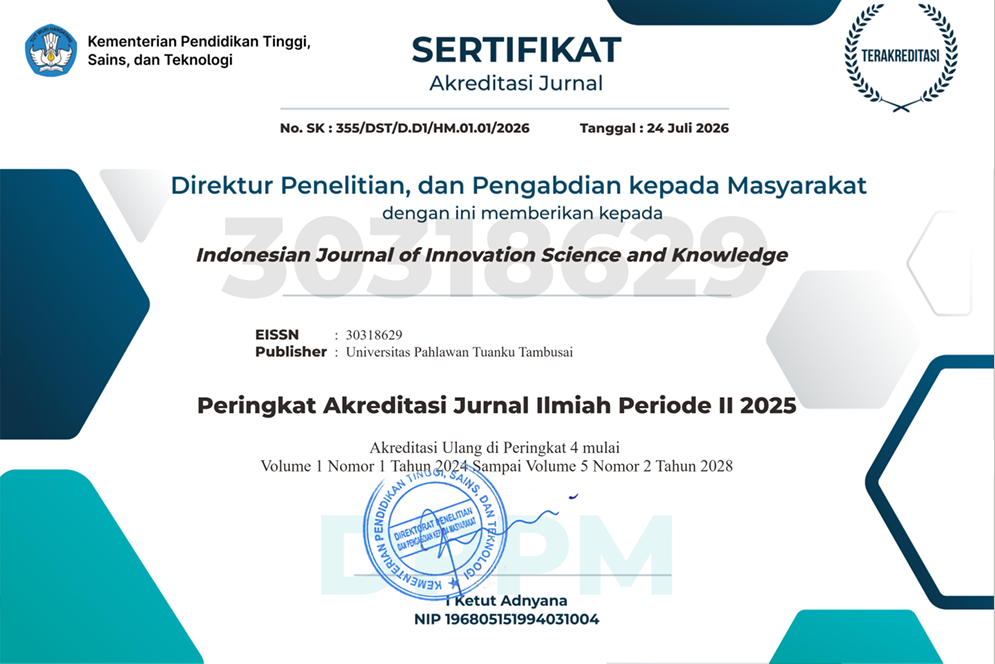
Analisis Kebutuhan Perawat Pelaksana Dengan Metode WISN Di Instalasi Rawat Inap RSUD Porsea Tahun 2026
DOI:
https://doi.org/10.31004/ijisk.v3i4.614Keywords:
Tenaga Perawat, Beban Kerja, WISNAbstract
Beban kerja perawat yang tinggi dapat memengaruhi kualitas pelayanan dan keselamatan pasien. Peningkatan jumlah pasien yang ditangani perawat berisiko meningkatkan stres kerja dan menurunkan efektivitas pelayanan. Penelitian ini bertujuan menganalisis kebutuhan tenaga perawat menggunakan metode Workload Indicator Staff Need (WISN) di Instalasi Rawat Inap RSUD Porsea. Penelitian menggunakan desain observasional kualitatif dengan analisis data kuantitatif. Pengamatan dilakukan berdasarkan tingkat ketergantungan pasien dan waktu produktif tenaga keperawatan, kemudian digunakan untuk menghitung kebutuhan tenaga perawat dengan metode Douglass dan WISN. Hasil penelitian menunjukkan bahwa beban kerja perawat berada pada kategori sedang sebesar 76,9%, dengan jumlah 21 perawat pelaksana. Waktu kerja tersedia sebesar 118.931,4 menit per tahun. Kegiatan keperawatan terdiri atas kegiatan langsung, tidak langsung, pribadi, dan nonproduktif. Standar beban kerja dan standar kelonggaran sebesar 0,183 juga telah diperoleh. Rumah sakit disarankan menyesuaikan tugas perawat dengan SOP serta mengurangi kegiatan nonkeperawatan.
References
Romadhoni RD, Pudjirahardjo WJ. Beban kerja obyektif tenaga perawat di pelayanan rawat inap rumah sakit. Jurnal Administrasi Kesehatan Indonesia. 2016;4(1):57–66.
Doosty F, Maleki MR, Yarmohammadian MH. An investigation on workload indicator of staffing need: A scoping review. Journal of Education and Health Promotion. 2019;8:22.
Nguyen TTH, Phung HT, Bui ATM. Applying the workload indicators of staffing needs method in nursing health workforce planning: Evidences from four hospitals in Vietnam. Human Resources for Health. 2022;19:124.
Najafpour Z, Zare Nasiri M, Nozarian MH, Keliddar I, Shayanfard K. Estimating the number of required nurses in different types of hospitals: An application of the workload indicators of staffing needs (WISNS) method. PLOS ONE. 2023;18(12):e0295213.
Shivam S, Roy RN, Dasgupta S, Bhattacharyya KD, Misra RN, Roy S, Saha I. Nursing personnel planning for rural hospitals in Burdwan District, West Bengal, India, using workload indicators of staffing needs. Journal of Health, Population and Nutrition. 2014;32(4):658–664.
Namaganda G, Oketcho V, Maniple E, Viadro C. Making the transition to workload-based staffing: Using the Workload Indicators of Staffing Need method in Uganda. Human Resources for Health. 2015;13:89.
Moreira J, et al. Assessment of staffing needs for registered nurses and licensed practical nurses at primary care units in Brazil using Workload Indicators of Staffing Need (WISN) method. Human Resources for Health. 2022;20:3.
Winvi FC, Nasution SLR, Ginting CN. Workload Indicators of Staffing Need (WISN) for the required estimation of nursing staff in a hemodialysis unit. Folia Medica Indonesiana. 2023;59(2).
Twigg DE, Whitehead L, Doleman G, El-Zaemey S. The impact of nurse staffing methodologies on nurse and patient outcomes: A systematic review. Journal of Advanced Nursing. 2021;77(12):4599–4611.
Dall'Ora C, Saville C, Rubbo B, Turner L, Jones J, Griffiths P. Nurse staffing levels and patient outcomes: A systematic review of longitudinal studies. International Journal of Nursing Studies. 2022;134:104311.
Kane RL, Shamliyan TA, Mueller C, Duval S, Wilt TJ. The association of registered nurse staffing levels and patient outcomes: Systematic review and meta-analysis. Medical Care. 2007;45(12):1195–1204.
Cho SH, Han YJ, Han KI, et al. Nurse staffing and nurse outcomes: A systematic review and meta-analysis. Nursing Outlook. 2018;66(4):1–12.
Lang TA, Hodge M, Olson V, Romano PS, Kravitz RL. Nurse-patient ratios: A systematic review on the effects of nurse staffing on patient, nurse employee, and hospital outcomes. Journal of Nursing Administration. 2004;34(7-8):326–337.
Doosty F, Maleki MR, Yarmohammadian MH. Workload indicators of staffing need (WISN): A systematic review of applications and implications for health workforce planning. Journal of Education and Health Promotion. 2019;8.
World Health Organization. Workload Indicators of Staffing Need (WISN): User's Manual. 2nd ed. Geneva: World Health Organization; 2023.